
Getting your credits home
A plain-language guide to how coursework from your partner program semester or year study away turns into Colorado College credit — and what to do, in what order, to make sure it does.
The single biggest predictor of a smooth credit transfer is starting early. Watch this short overview first — it walks through showing you exactly how to get courses approved in Summit, how to find what’s already been preapproved and how to add them to your plan, and what you should do to prepare academically before you leave:
Then talk to your academic advisor about what you want your time away to accomplish — toward your major, minor, all-college requirements, a language, or just personal growth. We’ve prepared this Academic Planning Worksheet that you can use for this advising conversation. Every student's goals are different, and every department has its own rules about what off-campus coursework counts toward a major or minor, so check your department's policy early.
Summit is your essential tool: Some programs let you register for courses before you leave; others finalize your registration on arrival. In both cases, your best bet is to use the "Course Approval Form" in Summit as an ongoing and essential tool throughout the process.
How? Enter your planned or potential course options in Summit on your Course Approval Form (part of your required CC Internal Application for Study Away Approval) as soon as you know them, and update your form if your enrollment changes once you're there — that's what actually confirms what will transfer, which requirements it satisfies, and whether anything you're planning to take won't come back to CC at all.
You can choose from the many pre-approved course options offered by our partner programs, and request new approvals through our Summit "Course Approval Form" system.
- Look to see which courses have already been reviewed and pre-approved in Summit. You’ll see all these options in Summit on your own Course Approval Form as part of the CC Internal Application for Study Away Approval process once you select your program; you’ll be able to easily add any already-approved class to your own form.
Alternately, outside of Summit, you can peruse all previously approved courses for all programs online in our searchable Course Approval Database, and filter results by major, minor, All-College requirement ("Registrar Types"), and specific program. - If you want to take a new course that has not been reviewed and approved previously, you’ll submit a new course approval request in Summit, on your Course Approval Form. Include as much detail as you have — a syllabus especially. Many departments require one, so if it's not on your program's website, ask them for it.
Once you submit a new request, the Registrar reviews it first. They determine whether it satisfies an All-College requirement (like a Critical Learning gen-ed, or the Language Requirement) and how many CC units it's worth. You'll see both results on your Course Approval Form in Summit. - If you’re requesting major or minor credit for a specific class, Summit gives you the option to “Apply to Major” or “Apply to Minor” — use it to automatically send the request on to the departmental chair once the Registrar has made their determination.
Not sure which courses are worth submitting for departmental credit? Ask your faculty advisor or department chair before you submit a long list — they can often tell you what they'll actually be looking for, and what might be the most likely to be approved for what you need. Many departments cap how many off-campus courses may count toward the major or minor, so it's worth understanding that limit in advance rather than after the fact.
How CC units, U.S. semester credits, and ECTS line up — and the floors and ceilings on what transfers.
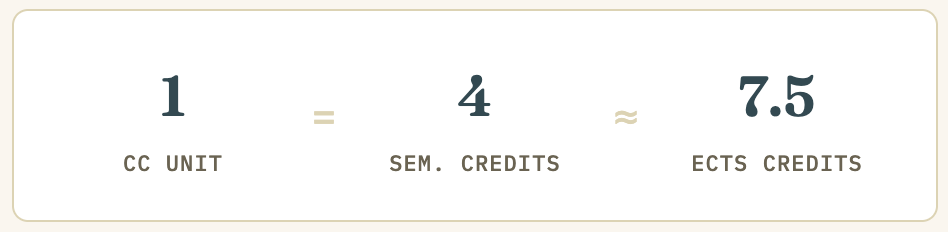
A full 4-block semester at CC is equal to 16 semester credits (30 ECTS). If your program awards credit some other way — or you'll get a transcript directly from a foreign university with a different credit system — the Registrar will calculate the CC unit equivalency for you in Summit. Your program should also have this credit equivalency information available on their website for the specific place/university you are headed to.
How many units should I take?
|
Minimum |
Whatever your program requires as a full course load — the bare minimum is usually at least 3 CC units / 12 semester credits; most students take 15+ semester credits. No exceptions are made to drop below your program's minimum. |
|
Maximum |
Up to 5.75 CC units can transfer back per semester, matching the most a student could earn on campus with overload permission. |
Work out your target courseload with your academic advisor — how many units you actually need to stay on track for graduation depends on your own academic plan.
Applying a 0.75 unit class?
A standard 3-semester-credit course transfers back as 0.75 CC units — but with Registrar approval in Summit, that 0.75 unit can fully satisfy an entire one-unit All-College requirement (like a Critical Learning gen-ed, or one unit of the Language Requirement).
A 6-semester-credit course works the same way at double the size: 1.5 CC units of approved language coursework can fully satisfy CC's 2-unit Language Requirement. Most (not all) departments extend the same logic to major/minor requirements — check with your specific department. Either way, you still need 32 units total to graduate.
The short version: liberal arts coursework that isn't a repeat of something you've already taken.
- It has to be liberal arts in nature, generally aligning with a discipline we teach here at CC. For example – Economics or Sociology, yes; hotel management or wine appreciation, likely no.
- No duplicates. Credit isn't awarded for a course that closely mirrors one you've already completed at CC.
- Keep your paper trail. Hang on to syllabi, papers, and exams — at minimum, syllabi — in case questions come up about credit or equivalency after you're back.
- Have your program send your final official transcript straight to the CC Registrar. For CC-approved partner programs, CC will accept the grade report directly from the program itself, so you don't need to route it through a "School of Record" for us.
- Keep in mind, if you plan to apply for grad schools later: some may require a transcript from an accredited "School of Record" for all undergraduate credit you earned, and in this case, you would need to ask your program to register you for this option before you study abroad.
What shows up on your CC transcript record depends on whether you're on a CC-led program or a partner/exchange program.
CC Faculty-Led Programs
➡️ Grades appear on your CC transcript and count toward your CC GPA, same as on campus.
➡️ You can opt into pass/fail — but only until the fourth class session, same deadline as on-campus courses.
➡️ If you need to change your grade track after arriving on-site, email registrar@coloradocollege.edu
Partner Programs & Exchanges
➡️ Everything transfers in to CC as transfer credit — this means course titles and units earned appear on your CC transcript, but no letter grade, similar to AP/IB credit. Transfer credit is not factored into your CC GPA.
➡️ All courses must be taken for a grade, and you need a C- or better for the credit to transfer.
➡️ Every course you attempt on a CC-approved partner program fall/spring semester or year away shows up on your CC transcript record — either as earned transfer credit if you passed with a C- or better (and the course was approved by the Registrar), or as 0.00 transfer units if you didn't.
Applying to grad school later? While your CC transcript won't show partner program/exchange grades, most graduate programs require an official transcript from every undergraduate institution you earned credit from — including your study away program. Admissions committees will see those grades directly, alongside your CC GPA and coursework.
- Internships transfer only if they're credit-bearing and appear as a class on your program transcript. That credit counts as general studies credit by default; a department only awards major/minor credit for an internship with its own additional review and approval in Summit.
- Planning to do independent research involving human subjects while abroad, and want that work to count toward your CC degree? Review your obligations on the CC Institutional Review Board (IRB) website before you begin.
If your program is in a country where English is not the native language, CC students are required to take one course studying that local language while you're there — regardless of whether it's Danish, Czech, Thai, Swahili, or anything else. (Students approved by CC Accessibility Resources for a disability-related language substitution can take a culture course instead.)
- If you’re also looking to earn credit towards fulfilling your CC Language Requirement (Critical Engagement Through Language) for graduation, the Registrar will consider classes both from traditional language acquisition coursework (i.e., a Spanish class, a French class), as well as topics and culture courses taught in the target language.
- If you take 6 semester credits or more of approved language study coursework, this can completely fulfill your CC Language Requirement (see "The credit math" section above).
- And, if you choose to take just one 3- or 4-semester credit language class abroad in a language CC doesn’t offer here, per the All-College Degree Requirement guidelines (see "Clarifications" under Language Study at the College Level), you can complete the other half of the Language Requirement at CC by taking one block of a different language that CC does teach.
What doesn't qualify towards the CC Language Requirement: immersion or homestay experiences alone. Those are genuinely valuable for building fluency, and we encourage you to lean into them — they just can't stand in for credit-bearing coursework toward the graduation requirement.
show all / hide all