

Generative AI Hub
Generative AI in Practice and Perspective
Political Economics Alum Designs AI in Business Ethics Class
By Julia Fennell ’21
After learning her recent college graduate daughter was asked to form an AI Council for her marketing consulting firm but did not know how to get started, Lora Louise Broady ’83, Visiting Executive in Residence of Economics and Business, realized CC students may be facing some of the same challenges. And she jumped into action.
“I immediately thought that CC students may be in a similar position—entering an AI-infused workplace upon graduation without much structure or experience,” Broady says. “I imagined that the most important aspects for CC students were to have a grounding in the ethics, equity, and impact areas of AI usage in the workplace, regardless of the field they would be entering. Equipping students with how to work responsibly with AI no matter the usage, to me, is aligned with the ethos of CC, and is important in the real world.”
Broady quickly spoke with the Department of Economics & Business. Within three months, she had designed and was ready to teach an AI in Business: Ethics, Equity, and Impact course, offered for the first time in January 2025.
With support from College leadership, Broady formed a “CC AI Confab” comprised of Computer Science students and faculty, ITS staff, and CC alumni. Together, the group brainstormed the learning objectives and curricular approach—with a focus first on learning about the core elements of responsible AI, then applying them to a real-life business through a student-consulting project.
“It was a collaborative thing of beauty to come together so quickly with the power of CC expertise,” Broady says.
Despite the short notice, the class was extremely popular and had a waitlist.
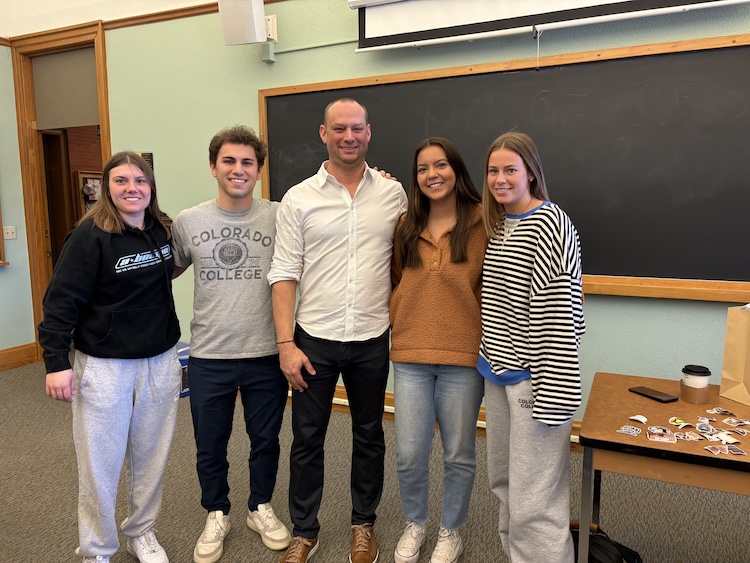
On the first day of class, students were divided into teams and assigned one of six businesses to serve as the group’s client. The groups then met with their client in an initial discovery session to learn about the business and the AI Governance challenge. Throughout the course, students learned how to conduct a client consulting project.
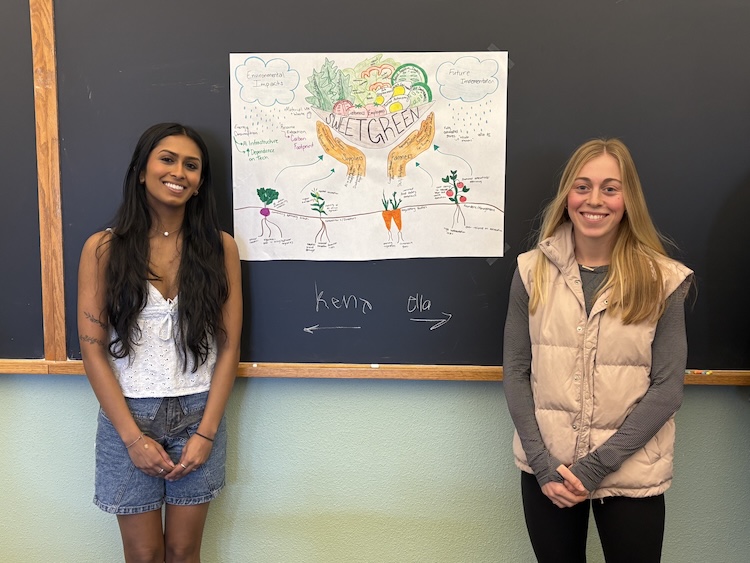
Students were tasked with creating AI Governance for their clients, which is a 15- to 25-page report that consists of recommendations for data governance, AI development, risk management and mitigation, oversight, and ethical considerations.
Broady taught the core concepts of responsible AI and, in parallel, her students researched how those concepts applied to their specific client challenge.
By the end of the block, each team finished their AI Governance recommendation report, created an executive presentation, and presented and delivered the report to their client.
AI in Business: Ethics, Equity, and Impact will be offered in Block 7, 2026, and has a 27-person waitlist.
“This class focuses on whether we should use AI and how to do it fairly—not on how to use AI,” says Broady, who will also teach the class in Block 4, 2026.
When Broady was writing her Political Economics thesis in Tutt Library, computers were not yet adopted at CC.
“Fast forward to today, as campuses all over the globe strive to instill critical thinking while preparing students for a professional landscape increasingly shaped by AI,” Broady says. “My hope is that CC students master its responsible use—understanding privacy concerns, algorithmic bias, and the various environmental and social consequences of this new technology.”
Generative AI in Practice and Perspective



Report an issue -
Last updated: 04/07/2026