

Generative AI Hub
Generative AI in Practice and Perspective
Department of Political Science Wrestles with AI
By Julia Fennell ’21
CC’s Department of Political Science continues to grapple with the reality of artificial intelligence (AI) use in the world while simultaneously acknowledging the ethical issues surrounding it as AI rapidly changes the face of governance and politics.
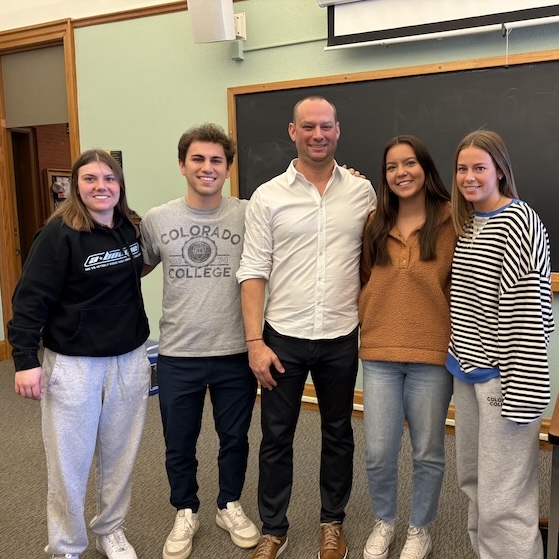
Associate Professor of Political Science Dana Wolfe talked to her Fall 2025 United States Politics and Government class about how AI affects a liberal arts education. Wolfe is concerned that when students use AI, they are not building the necessary skills to go into the workforce after college.
“[Professor Wolfe’s] pitch resonated with students … she framed it as, ‘Why are you paying so much money to go to this college and possibly putting yourselves into debt if you are not going to learn these important skills and just using ChatGPT?’” says Peyton Kifer ’28, who took Wolfe’s Block 2 class.
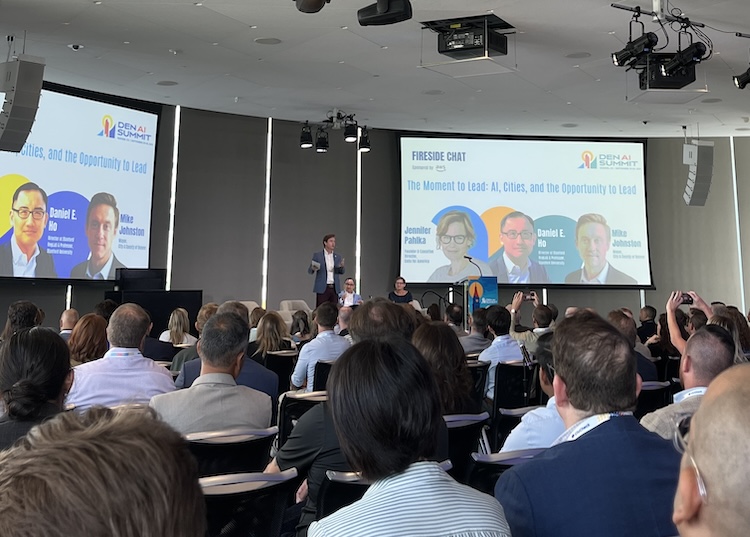
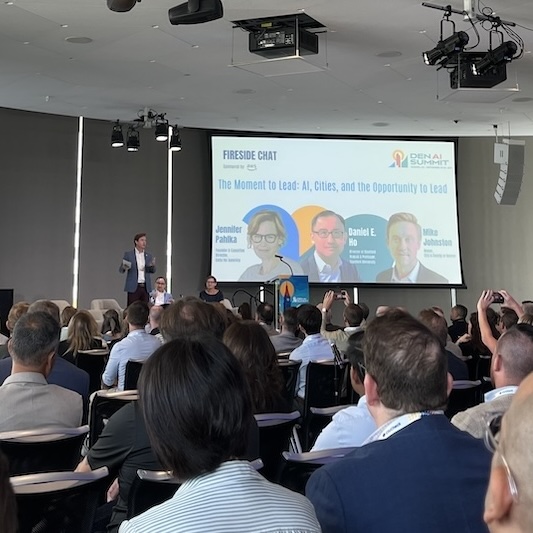
In the fall of 2025, Wolfe nominated Aiden McLean ’26 and Olivia Weinstein ’26 to attend the Denver AI Summit, an annual conference about AI for businesses, local governments, entrepreneurs, and researchers.
“It was an incredible experience hearing from founders, mayors, non-profit executive directors and the like about what the future of AI in public service looks like,” says McLean, a History-Political Science major. “We were able to hear from all corners of the world of government about how AI can be ethically and meaningfully integrated in municipal and state-level operations.”
Before attending the Summit, McLean researched how AI has been leveraged by government organizations.
“To me, this was the crux of the Summit: how can AI be used for good governance? Having at least a rudimentary understanding about where we’re at now, so to speak, helped me better understand the Summit’s discussions of where we’re going,” McLean adds. “Since then, I do see AI as a new frontier, especially in governance,” he says.
One of the most impactful parts of the event for McLean was attending a panel with Executive Director and Founder of Code for America Jennifer Pahlka, where panelists talked about the meteoric rise in complexity in federal, state, and municipal codes, zoning, and regulations.
“For years, this has made the government’s provision of services, permits, and everything else—for the most part—less and less efficient,” McLean says. “AI, Pahlka suggested, offers a remedy for this, a way to take the heavy, menial burdens off of public servants and make providing good governance easier.”
McLean hopes the Political Science Department will add more courses about AI’s impact on policymaking, politics, and governance in the future. “In many ways, it seems as though AI will characterize the future of politics, and understanding how we can leverage it to make government better would prove incredibly valuable,” McLean adds.
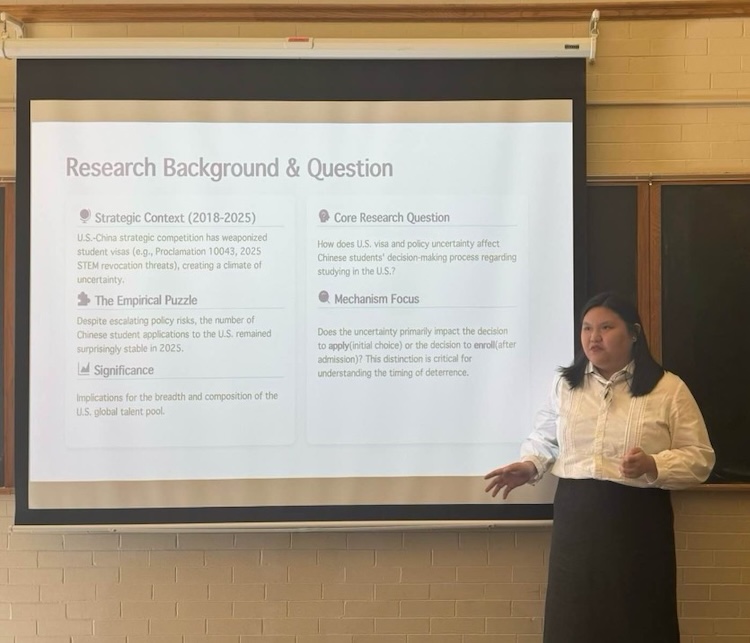
Soon after ChatGPT became publicly available, Political Science Professor John Gould gave an essay prompt to ChatGPT and had students use course material to critique and augment the AI response.
“The best student essays used course material to reveal how ChatGPT could have gone a lot further in its first-cut response, and a few students even found evidence of bias in the evidence ChatGPT used in building its answer,” Gould says.
Gould engages students in all his classes in ongoing conversations about the ethical, environmental, political, surveillance, and other implications of AI innovations as they continue to develop rapidly.
“Before using any AI-sourced finding in a paper or a presentation, I ask students to ‘find the human’ who generated the knowledge that AI is synthesizing, give the original sources critical consideration, and of course credit them for their intellectual and creative labor,” Gould says.
Political Science major Perilla Wang ’28 believes AI in politics requires an especially cautious approach.
“Many issues remain in a gray area: How should algorithmic decision-making be monitored? Who is responsible when errors or bias occur? Can democratic institutions keep pace with rapid technological development? At the same time, questions about power are central: Who controls the data? Who designs and governs the algorithms? And ultimately, who is being governed or decided by them?” Wang asks.
For these reasons, Wang believes the Political Science Department would benefit from offering courses that explicitly teach students how to engage with AI in a responsible way, rather than treating it solely as something to prohibit.
Ultimately, there is no easy answer to the best role of AI in governance or in the Political Science Department, but campus members will do what they always do: research, discuss, collaborate, and work together to find the best solution.
Generative AI in Practice and Perspective



Report an issue -
Last updated: 04/07/2026