

Generative AI Hub
Generative AI in Practice and Perspective
Dan Schmidt ’25 Built a Chatbot Prototype—Then Began Questioning AI Ethics
By Julia Fennell ’21

When Dan Schmidt ’25 faced difficulty finding information and resources across a dispersed campus, he decided to confront the issue firsthand—first by building his own chatbot, and then questioning whether it should exist at all. Schmidt worked on the chatbot, named TigerMouth, in his 2024 Design Workshop class alongside Chris Moller, a friend who worked at a tech start-up.
“The project addressed a common frustration at CC: our information ecosystem is incredibly fragmented across dozens of websites,” says Schmidt, who majored in Computer Science. “After talking with peers, I realized this was a widespread issue. So, I proposed a centralized chatbot where campus members could ask any CC-related question and get pointed to the right resource.”
Schmidt and Moller created an interface using Claude's API and fed it scraped information from CC's websites. Students could ask questions like, “What business classes are being taught in Block 6?” and TigerMouth would respond with the courses, plus a link to the department’s schedule. Students could also ask about upcoming events, and TigerMouth would respond with information from the campus calendar.
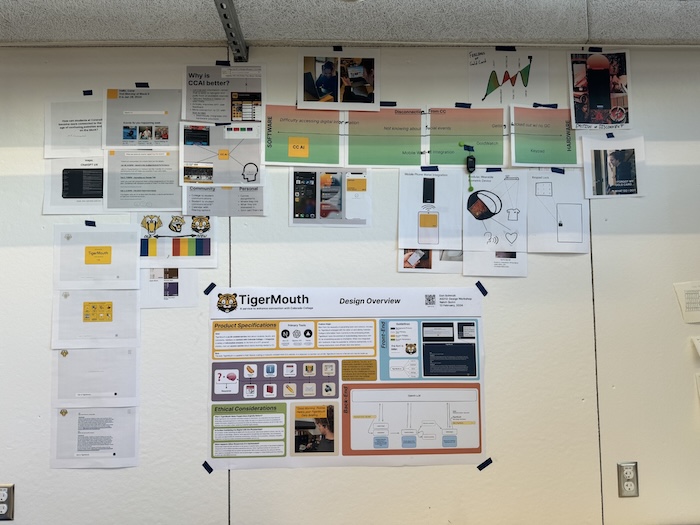
Design Workshop is an Art Studio class, and most of the students in the class were creating physical interventions. Schmidt was one of two students building a digital service, and Visiting Instructor Natch Quinn ’11 gave him freedom to explore different ideas.
“This work raised important questions about data ethics that became central to my path forward,” Schmidt says. “I scraped CC's websites without asking anyone, and when my Computer Science advisor raised concerns, I initially felt defensive. But sitting with that discomfort opened up harder questions. Scraping is how most AI systems get trained: taking without consent, then selling convenience back.”
Schmidt then had another thought: What if the struggle to find information was actually valuable?
“Maybe not knowing where to find things forces you to ask someone,” Schmidt says. “Maybe that's how you learn who knows what and community is built. I didn't have answers and felt wary about going forward with development, which is partly why I didn’t continue developing it.”
Instead, Schmidt served as a student facilitator for CC's AI Task Force the following year, helping the group analyze the ethics surrounding generative AI.
The AI Task Force connected with a group of Computer Science students who built their own version of a chatbot called TigerOne, which relied less on scraped data and more on what their LLM could find publicly online.
Schmidt says if he were to create TigerMouth today, he would spend more time talking to campus members about their concerns and then find ways to address those concerns when first creating the service.
“I don't have a clear answer for how to ethically build something like TigerMouth yet,” Schmidt says. “But the discomfort I felt, the sense that something was off even when the intentions were good, that's what I’m trying harder to listen to and collaborate with.”
Schmidt is a 2025 Watson Fellow and is traveling the world exploring how digital platforms shape our relationships with time, attention, and each other through his project, “The Ecology of Social Technology.”
“In each place, I'm learning from people building technologies that respect human rhythms rather than exploiting them,” Schmidt says. “Right now, I'm in Green Valley, in southern Japan. The name is intentional, a play on Silicon Valley. It's a place where burned-out tech workers are trying to forge a more harmonious relationship with the land and their lives.”
Schmidt says this pattern is everywhere: people are exhausted by technology but feel powerless to change it.
“My purpose lies in finding alternatives: through design, through policy, through caring discussions,” Schmidt says. “I want to lead a career that helps us build social technologies that are healthier for societies. Not by rejecting technology, but by insisting it can be better.”
Readers can visit Schmidt’s website to learn more about his work.
Generative AI in Practice and Perspective



Report an issue -
Last updated: 04/07/2026