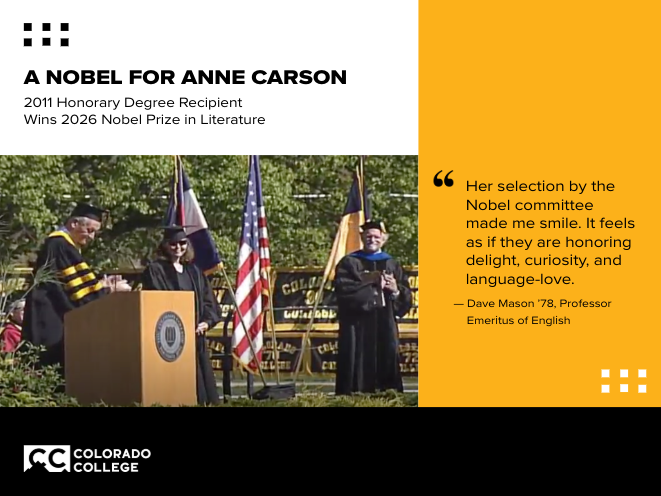
Anne Carson, the Canadian poet, essayist, and translator, who received an honorary degree from Colorado College in 2011, was awarded the 2026 Nobel Prize in Literature on Oct. 8.
“Her selection by the Nobel committee made me smile. It feels as if they are honoring delight, curiosity, and language-love,” said Dave Mason, ‘78, Professor Emeritus of English.
Mason first brought Carson to Colorado College in 2004 as a participant in the College’s Visiting Writer Series. Her performance in the Visiting Writers Series was “funny and touching,” said Mason, who worked together with Jonathan Lee, Professor Emeritus of Philosophy, to honor Carson with an honorary degree in 2011.
The College awarded Carson an honorary Doctor of Humane Letters degree at its 129th Commencement on May 23, 2011, alongside commencement speaker Mark Fiore '91 and then-President Richard F. Celeste.
At Commencement, Lee praised Carson as one of the world's great contemporary writers: “A classicist of the first rank, a spectacular translator (from Greek, Latin, and German), a brilliant poet, and a remarkable philosopher/critic, Anne Carson is quite simply one of the great writers at work in the world today.”
The Swedish Academy echoed that assessment, honoring Carson “for her bold and inventive oeuvre that, in playful dialogue with the classical tradition, has created new forms for contemporary literature.”
“There is something powerful going on today with the resurgence of interest in classical Greek literature. I don't just mean Christopher Nolan's movie, “The Odyssey.” I mean that artists and audiences are finding the modernity of the ancients,” Mason said. “Classicist poets like Anne Carson, Alice Oswald and A. E. Stallings have made great contemporary contributions rooted in the ancient past, in regard to language and the tragic-comic vision of who we are and what it means to be alive on earth.”
Ancient sources, new forms
Born in Toronto, Carson fell in love with Greek and Latin early in life and earned degrees in classics from the University of Toronto. Her best-known book, “Autobiography of Red,” is a novel in verse built from surviving fragments by the Greek poet Stesichorus. It recasts the myth of Geryon, the red-winged monster slain by Heracles, as a love story about a modern young man. Its publisher, Alfred A. Knopf, reports the book has sold nearly 100,000 copies in the U.S. alone.
In 2001, Carson became the first woman to win the T.S. Eliot Prize for Poetry for her collection of poetry, “The Beauty of the Husband: A Fictional Essay in 29 Tangos,” which tells the story, in narrative verse, of a doomed, destructive marriage. That same year, “Men in the Off Hours,” a collection of poetry and prose, won Carson the Canada's Griffin Poetry Prize. Her other works include “Norma Jeane Baker of Troy,” which sets Marilyn Monroe alongside Helen of Troy.
Her translations of classical Greek literature, which the academy said can be read as independent works, include “If Not, Winter: Fragments of Sappho,” “Sophocles' Electra,” and “Grief Lessons: Four Plays by Euripides.”
Carson has also collaborated with dancers and musicians, including Laurie Anderson and Lou Reed, and has received Guggenheim and MacArthur fellowships. She has taught classics, translation, and artistic collaboration at several U.S. universities. Carson, 76, has lived in Iceland, where she and her husband, Robert Currie, were granted citizenship in 2022.
At CC's 2011 Commencement, Lee concluded his tribute to Carson by pointing to her own description of poetry, from “Economy of the Unlost,” as an act of memory that preserves what would otherwise be lost.
“It is through her preservation of such grace,” he said, “that Anne Carson herself has emerged as a great poet and thinker.”
News
Anne Carson, Honored by Colorado College in 2011, Wins Nobel Prize in Literature
Read More