
Nearly everything we see—from mountains and oceans to our own bodies—is made from protons and neutrons. Yet physicists still don’t fully understand how those tiny particles work.
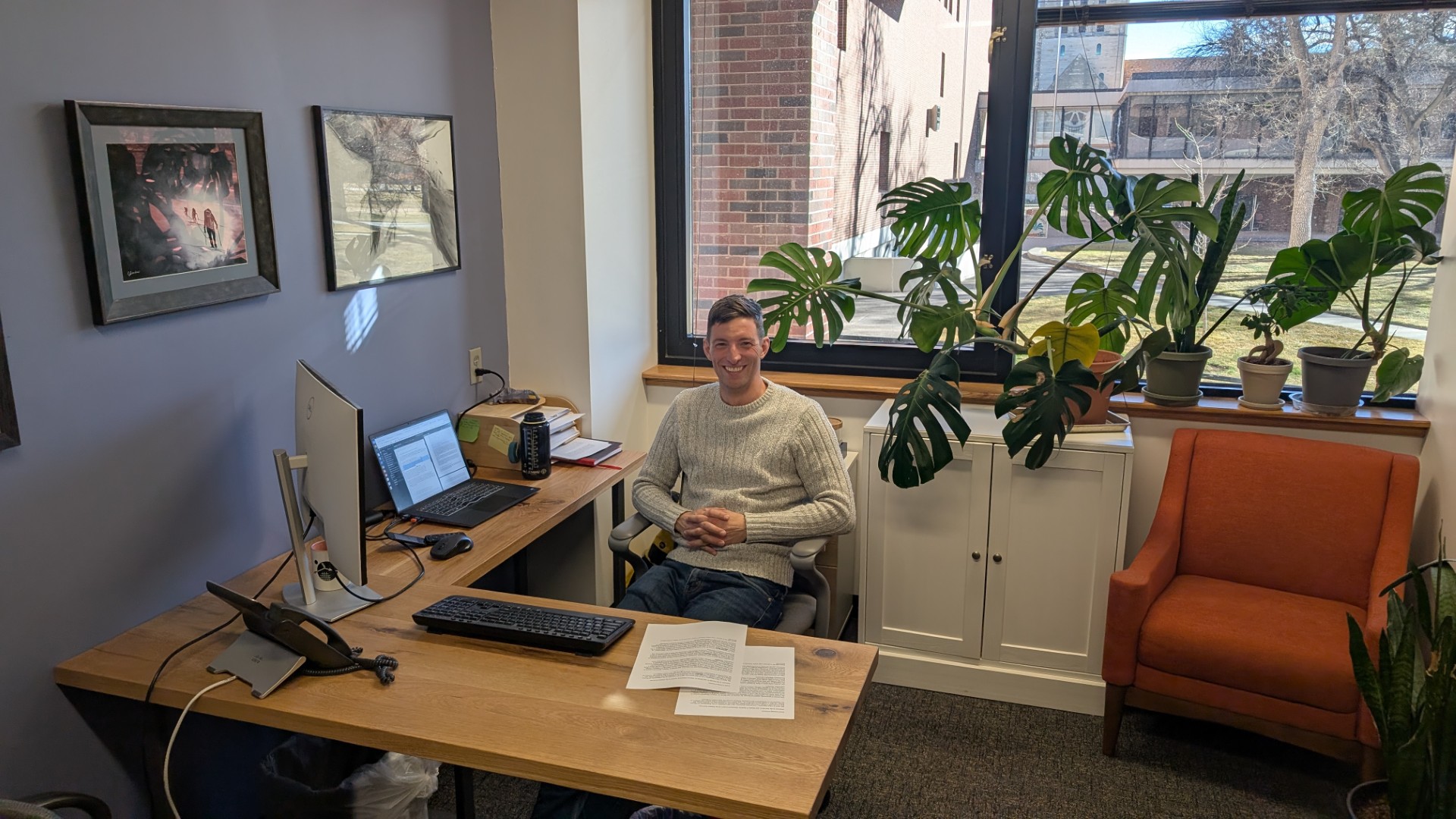
For Christopher Monahan, assistant professor of physics at Colorado College, that’s one of the most compelling mysteries in modern science.
“When we say we don’t understand protons and neutrons, we’re admitting that we don’t understand 95 percent of the mass of the visible universe,” Monahan told the U.S. Department of Energy’s Thomas Jefferson National Accelerator Facility (Jefferson Lab). “It’s a mystery at the heart of matter.”
Monahan and an international team of collaborators, Joe Karpie (Jefferson Lab), Kostas Orginos (William & Mary), and Savvas Zafeiropoulos (Centre de Physique Théorique), have developed a new way to compare theoretical predictions with experimental observations, helping scientists study the internal structure of protons and neutrons with greater precision.
Their work, “Window Observables for Benchmarking Parton Distribution Functions,” was published in November 2025 in Physical Review Letters, one of the most prestigious scientific journals for physics research in the world.
Their findings introduce a new framework that allows researchers to compare the most reliable portions of supercomputer simulations with experimental data. The approach provides a clearer way to test competing theories and strengthens confidence in the conclusions scientists draw about the building blocks of matter.
“This is exciting, because it finally allows us to work together as a community to really make sure we understand what is happening inside protons and neutrons,” Monahan adds. “My hope is that our work will place our understanding of proton structure on a much more secure foundation by cross-checking different calculations against each other.”
Natalie Gosnell ‘08, associate professor and chair of Colorado College’s Physics Department, says the work is important not only because of the scientific advance itself, but because of where it appeared.
“Being accepted to Physical Review Letters, a very selective and high-impact journal, means the discipline at large believes this will be impactful and important work,” Gosnell says. “Dr. Monahan’s paper is not only important to the computational particle physics community, but the experimental community as well,”
The research grew from conversations among collaborators at institutions in the United States and Europe. Monahan credits support from Colorado College and the U.S. Department of Energy with making those collaborations possible.
Funding from the College allowed him to attend a workshop at Jefferson Lab, where discussions with colleagues helped transform an early idea into a research project that could be rigorously tested.
That work later became part of a Department of Energy $410,000 grant awarded in 2025 to support research aimed at improving scientists’ understanding of the nucleon—the collective name for protons and neutrons—and how its internal structure can be mapped. This project laid the foundation for mapping the internal three-dimensional structure of the nucleon.
“To my knowledge, this is Colorado College’s first Department of Energy research grant,” says Tess Powers, director of sponsored research. “It reflects the caliber of research taking place across campus.”
Monahan has spent over a decade researching the internal structure of protons and neutrons. Along the way, he was named a 2022 recipient of the Early Career Research Program award through the U.S. Department of Energy and earned a CAREER award from the National Science Foundation (NSF). He was awarded the 2024 Phi Beta Kappa Award for the Advancement of Scholarship, by the Alpha Chapter of Virginia of Phi Beta Kappa.
In 2023, Monahan served on the Particle Physics Project Prioritization Panel, which meets every decade to make recommendations to the NSF and U.S. Department of Energy on the primary funding priorities in particle physics research for the country over the next ten years. He was also recently selected as a 2026-28 Kavli Institute for Theoretical Physics (KITP) Scholar.
For Monahan, however, the motivation remains simple.
Every new discovery brings scientists one step closer to understanding the invisible forces and particles that make up the universe—and our place within it.
Some of Monahan’s published papers are available here, and readers can keep up with Monahan’s research on his website.