For many college students, summer is a time for rest, internships, or travel. For Doe Reh, a Karenni American Bonner Fellow, it was a homecoming. Born in Section 8 of a Karenni refugee camp along the Thai Myanmar border and immigrating to the United States at the age of three, Reh returned to his birthplace to spend two months teaching English at Deeku Education Center (DEC) and KnNC. What he thought would simply be an internship, a chance to teach, complete a project, and make some sort of difference—became a journey of self-discovery, resilience, and reconnection. As he stared out the airplane window on his way to Thailand, only one thought came to mind: his students. Some orphans, some far from their homes, but all fight for a better future.
The path to completing his internship was not without obstacles. Due to heightened tensions between Karenni refugees and Thai law enforcement, Reh was told on his second day in Nai Soi that foreigners were no longer allowed to stay overnight in the camp. Commuting on foot took about three hours, and sneaking in on a motorcycle was not ideal. "I knew there was no going back," Reh recalled. He chose to go off-road by foot for the first few days and then made the trek in and out every weekend. Living in the camp meant no electricity, no running water, and none of the comforts he had grown accustomed to in America. Yet he never wavered. "Nobody forced me to spend two months of my summer in a refugee camp," he said. "But I knew one thing: this was my people, and this was my home."
Reh became the first Karenni American college undergraduate to complete an organized project in the camp. He organized a GoFundMe campaign that raised over $3,000—more than 100,000 Thai baht—to help alleviate DEC's burden of operating without a daily budget for necessities like notebooks, pencils, and running water. He also organized a two-month GED curriculum, taught 64 students across two colleges, and helped plan school fundraisers and events.
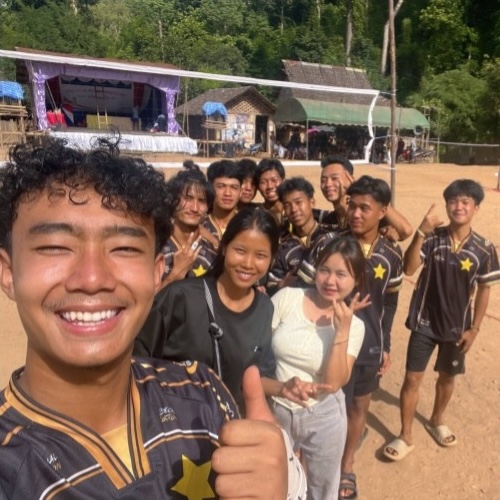
Beyond the classroom, Reh found joy in the small moments: eating lunch with his students every day, playing volleyball on a makeshift field in the mountains every Friday, and hiking an hour up the mountain with two students just to get one bar of signal to watch a World Cup match. These moments helped block out the present pains of camp—the poverty, the lack of basic humanitarian necessities, and the high suicide rate.
On his last day, the students rearranged their desks into one long table, reminiscent of Da Vinci's The Last Supper, to share all their home-cooked meals for the last time. "See You Again" by Charlie Puth and Wiz Khalifa played softly as Reh was handed in two wrapped gifts. The first was a beaming red traditional Karenni shirt—the exact same one he had planned to buy before leaving camp. "It was as if my students had come to know me as more than just a teacher over the last two months," he said. He joked, "You guys know I'm not dying, right?" and the room burst into laughter. Then came the letters. One by one, he read the heartfelt notes each student had written. One student wrote: "One thing I will always remember is when you say 'you can do it. Come on'...You are with us, talked with us, laughed with us, and made us feel comfortable...I hope that one day, when I achieve my goals, I can proudly say that one of the teachers who inspired me was you." Tears streamed down faces across the room. "I myself did not cry as I am not much of a crier," Doe Reh admitted, "but the scene was enough for me to feel a type of way I have not felt in a long, long time."
Reflecting on the experience, Reh said, "My people taught me that happiness doesn't always come from having more. That community can mean more than material possessions. Most importantly, the camps reminded me of where I came from." He added, "Coming back to Thailand was supposed to be an internship. Instead, I came back to a bigger part of the puzzle which was the missing puzzle pieces my soul had been missing. Home."
Reh encourages students—not only within Bonner—to apply for international grant funds. "I genuinely believe you do not live and have understood life until you physically travel the world and put your feet into someone else's shoes," he said. He also hopes Bonner will continue to support him in sharing the culture, resilience, and beauty of the Karenni people, who are caught up in the deadliest unknown civil war in Southeast Asia. He envisions future students continuing his endeavors in the Karenni refugee camps through weekly online classes, CC news publishing, and screenings, and he hopes the door remains open for ongoing support of DEC and KnNC students back home.
Reh's summer in DEC and KnNC was not just an internship—it was a homecoming. Through challenges that tested him physically, emotionally, and spiritually, he discovered that the refugee camp he left as a child was not a chapter to be closed but a foundation to be honored. His message is simple yet profound: sometimes, the greatest journey is the one that leads you back to where you began.