
For High School Counselors
You know your students best. We value the perspective, advocacy, and care you bring to the college search process, and we’re grateful to partner with you as students explore whether Colorado College is the right fit.
This page is designed to give you quick access to the information and tools you use most often: admission updates, visit opportunities, student data, counselor resources, and direct connections to our admission team.
Quick Links
Join Our Mailing List
Receive admission updates and counselor programming announcements. If you’ve recently moved to a position at a new school, completing this form will update your information for us in Slate and add you to your new school’s record.
Slate.org Access
Access select application information and support your students through Slate.org.
Class Profile
Explore information about our most recently admitted class and our most recent admit numbers by round.
Admission Directory
Connect directly with the admission counselor who works with your school or region.
Group Visit Request
Interested in bringing students to campus? Submit a request, and we’ll work with you to coordinate your visit.
Campus Visits
Planning your own visit? Join one of our regularly scheduled information sessions and tours.
Frequently Asked Questions
Short answer: submit scores. CC is test-optional and no-harm, so a student’s scores can only help their application, never hurt it. Students choose whether to submit SAT or ACT scores (self-reported scores are fine for the application), and we review those scores alongside everything else. If the scores strengthen a student’s academic profile, they become part of our holistic review. If the transcript tells a stronger story than the scores do, we lean on the transcript and set the scores aside entirely.
We built the policy this way on purpose: to take the pressure off students and families trying to determine if submitting scores is the "right" choice, to make your job advising them a little easier, and to give every student the best shot at putting their strongest application forward.
One note for after admission: we ask enrolled students to submit official SAT or ACT scores if they have them, even if they applied without scores. That’s not about re-evaluating anyone—it just helps us report testing data that reflects our full incoming class, not just the students whose scores factored into admission. Scores can come directly from the testing agency or through you, the student’s counselor.
- Openness to new experiences. CC students are willing to step into unfamiliar territory. They take classes outside their comfort zones, explore new interests, and embrace opportunities they didn’t expect to find when they arrived.
- Independence. The CC experience offers a great deal of freedom, and students who thrive here are comfortable making decisions for themselves, seeking out opportunities, and taking ownership of their education.
- Engagement. CC students take part in campus life with enthusiasm. In addition to engaging in their own interests, they are present for and celebrate their friends’ accomplishments and passions, whether or not they share those same interests.
- Kindness toward others. The Block Plan works best when students show up for one another. We look for students who are empathetic, generous, and genuinely interested in helping others succeed.
- Comfort with taking risks. Growth often happens when things don’t go exactly as planned. Students who are excited to challenge themselves, be present with discomfort, and learn from setbacks are the ones who make the most of their time at CC.
- Flexibility and adaptability. The CC experience is an adventure—both inside and outside the classroom. Students who thrive here can adjust to new challenges, manage changing priorities, and remain open to where their interests might lead.
- Strong communication skills. On the Block Plan, students move quickly from reading and discussion to drafting, revising, and refining ideas. Students who thrive here articulate their thinking clearly (both verbally and in writing), engage with complex texts and ideas, and respond thoughtfully to feedback from peers, tutors, and professors.
- A desire to define success for themselves. Many—perhaps most—students arrive at CC without a rigid plan for the future. They’re excited to explore possibilities, discover new interests, and chart their own course rather than follow someone else’s idea of success.
Students often arrive at CC with a few of these characteristics already well-developed and an enthusiasm for growth in other areas.
Yes, CC meets 100% of every admitted student’s demonstrated financial need. To be considered, students need to submit both the CSS Profile and the FAFSA by their chosen admission deadline. Once their applicant portal opens, students applying for aid will also need to submit additional documentation, like tax returns and W-2s, directly through that portal—we don’t use the iDOC system.
One thing worth flagging for your students: we can’t release an admission decision until a student’s full financial aid application is in, so it’s worth reminding them not to leave any piece of it for later.
Students from Colorado, Arizona, New Mexico, or Utah get even more robust aid through our Four Corners Pledge—worth mentioning if any of your students fall into that group.
At Colorado College, a deferral is often a foot in the door. In fact, we typically admit the majority of students who remain in our process after being deferred. If you have a student who was deferred from Early Action (which is common) or Early Decision I (which is less common), encourage them to stay engaged with us and continue through the admission process.
We’ll provide clear instructions about next steps, including selecting a subsequent application round (Early Decision II or Regular Action), completing the defer reply form, and identifying opportunities to engage with CC. If a student has not yet formally connected with us, we encourage them to attend a virtual information session before submitting their defer reply form.
The narrative portion of the defer reply form should focus less on providing a list of new accomplishments and more on helping us understand why the student remains interested in Colorado College and how they envision contributing to and engaging with our community.
The waitlist process is less straightforward. Students who are waitlisted will receive instructions about how to opt into the waitlist, but our ability to make waitlist offers often depends more on enrollment needs and budget considerations than on the strength of a student’s waitlist response.
Students who remain interested in Colorado College should complete the waitlist reply form. At the same time, we strongly encourage them to use the May 1 national reply deadline to secure their spot at another school where they have already been admitted. The number of waitlist offers we’re able to extend can vary significantly from year to year.
We do not have an engineering major, but there are a few different paths to becoming an engineer from CC. The right one depends on the student’s goals and what they are looking for in their college experience.
3+2 (Combined Program)
CC partners with Columbia University for a 3+2 option: students spend three years at CC, then apply to transfer to Columbia for two more years to earn a second bachelor’s degree in engineering.
- Most students major in physics, math, chemistry, or computer science to fit the prerequisites.
- It’s a structured path, and our students have a relatively high admit rate.
- Because of the requirements, it can limit how much a student explores CC’s curriculum unless they come in with prior credits or extend to a 4+2 timeline.
Engineering via a master’s degree
Another popular route is completing a BA at CC and then pursuing a master’s in engineering. This offers more flexibility and is a strong option for students interested in project management, leadership, innovation, or entrepreneurship. Last year, about a third of our graduating physics students went directly into an engineering master’s program.
Engineering with a CC degree (most common)
Many students major in a science or math field and go directly into engineering roles after graduation—especially in areas like aerospace and tech. This pathway doesn’t always work for students who need the Professional Engineer (PE) certification, but otherwise is the most common route to an engineering career from CC.
Below is a sample of engineering roles currently filled by CC physics alumni:
- Space Systems Engineer at Sierra Space
- Architectural Engineer at National Renewable Energy Lab
- Hardware Engineer at Sofar Ocean Technologies
- Optical Engineer at Lockheed Martin
- Manufacturing Engineer at SpaceX
- Software Engineer at Numerated
- Principal Engineer at Williams-Sonoma, Inc.
- Product Engineer at Hubbell Power Systems
- Senior Mechanical Engineer at TerraClear Inc
Yes, and for your students, it’s a low-pressure way to get a real feel for CC straight from someone actually living it. Interviews are optional and hosted by our senior admission ambassadors—current students, not admission staff—so it’s a conversation (not an evaluation). Nothing said in the interview helps or hurts an application; it’s simply a chance to ask questions and hear an honest, student’s-eye view of what CC is really like. Encourage your students to come with a few questions so they’re ready to make the most of it.
show all / hide all
Why Colorado College?
Colorado College is a nationally recognized liberal arts college in Colorado Springs, built around the Block Plan: students take one course at a time, in immersive 3.5-week blocks. The whole campus moves through the same rhythm—mornings for focused learning, afternoons open for collaboration or recharge—sharpening focus and pushing students to test ideas, learn through curiosity, and cross boundaries.
That boundary-crossing spirit is built into where CC sits, too. At the intersection of the Rockies and the Southwest, geography shows up directly in the coursework: professors take students into the field to study ecology in the mountains, engage with Southwest communities, or work with organizations just blocks from campus.
The Block Plan builds habits that endure long past graduation. Students learn to:
- Sharpen focus and time management.
- Build close relationships with professors and peers.
- Take intellectual risks and pursue interdisciplinary interests.
- Adapt quickly and think deeply.
- Navigate change with confidence and purpose.
Talking Points for Conversations With Students
show all / hide all
Outcomes
The Block Plan develops habits of focus, resilience, and intellectual agility that serve students long after graduation, especially in uncertain economies.
Colorado College graduates pursue careers and advanced study across medicine, business, education, public service, scientific research, entrepreneurship, the arts, and more. They carry with them the ability to learn quickly, communicate effectively, and adapt to changing environments.
Explore more:
- Outcomes (including retention rate, graduation rate, and career pursuits)
- First Destination Surveys
- Student and Alumni Stories
Financial Aid and Scholarships
Colorado College meets the full demonstrated financial need of all admitted students.
Need-based aid eligibility is determined using the FAFSA, CSS Profile, and prior-prior year tax information. We encourage families from all income backgrounds to use our Net Price Calculator to estimate what a Colorado College education may cost them.
In addition to need-based assistance, Colorado College offers a limited number of merit scholarships to students within the strongest segments of our applicant pool, as well as several competitive scholarships that require separate applications.
Explore more:
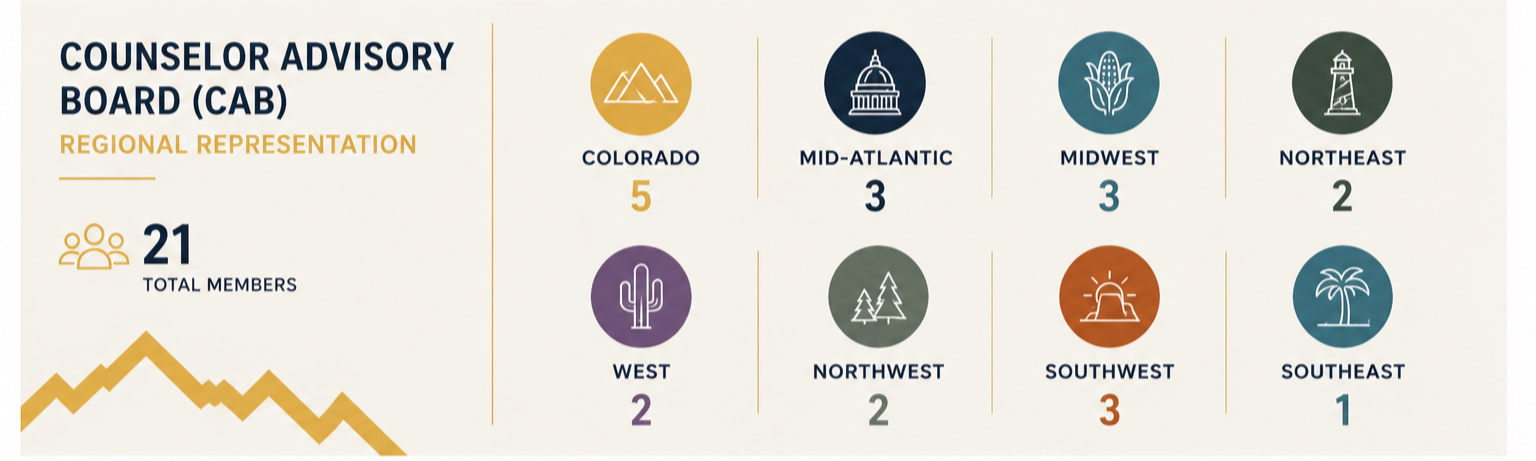
Counselor Advisory Board
Colorado College’s Counselor Advisory Board provides valuable insight into the evolving landscape of college admission.
Board members serve three-year terms and support our admission team in several ways:
- They provide feedback on admission communications and processes.
- They share perspectives from secondary schools and community-based organizations across a variety of contexts.
- They serve as thought partners as we strengthen our relationships with counseling professionals.
Interested in learning more about future opportunities to serve? Contact your admission representative.
Professional Development Resources
Podcasts
Publications and Newsletters
Need something specific?
If you’re looking for information that isn’t included here, or need context related to a particular student situation, we’re here to help. We value the partnership we share with school counselors and look forward to working with you throughout the admission process.