
Costa Rica - EV209 - Ecology & the Environment
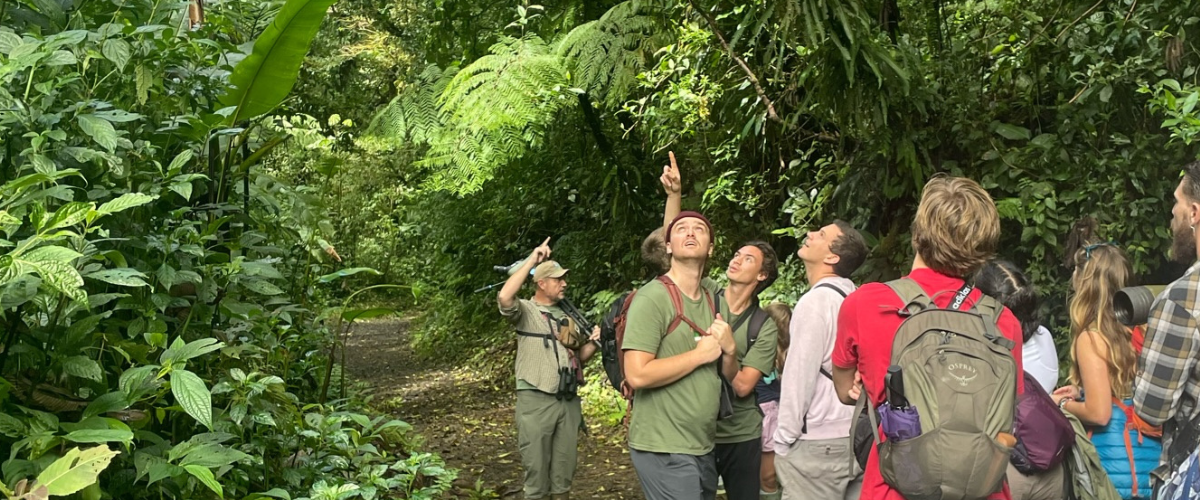
The analysis of distributions, abundances, and interrelationships of organisms, populations, communities, and ecosystems with emphasis on tropical rain forests, cloud forests and agriculture. The course includes daily 4+ hours of fieldwork. It is taught in primary and secondary forests and coffee farms in the Monteverde Area of Costa Rica.
Course led by Prof. Miro Kummel
Course Info
BLOCK: Block 3, Fall 2026
COURSE NUMBER: EV209
COURSE FULL NAME: Ecology & the Environment
COURSE LOCATION(S): Monteverde Region, Costa Rica
FACULTY LEADER(S): Prof. Miro Kummel
PREREQUISITES: EV128: Introduction to Global Climate Change
MAJOR REQUIREMENTS MET: Contact Environmental Studies/Sciences for information on the application of this course to their major program(s).
COLLEGE REQUIREMENTS MET: This course is not approved to meet any collegewide requirements.
THIS PROGRAM IS OPEN FOR NEW APPLICATIONS
Applications for this Spring 2027 course are currently closed.
Programs later in the 2026-2027 Academic Year may currently be open. This program may also be offered in future years. Please check with the program faculty to ask if they intend to repeat the course.
Financial Info
Course Fee: $2,900
Included/Not Included in Fee: Fee includes all on-site lodging, transportation, group meals, excursions & group activities, and international health & travel insurance. Not included in the fee is airfare to/from Costa Rica or individual meals. All students who have a full meal plan at Colorado College will receive a one-block refund of their meal fund with those funds available for on-site meal costs.
How to Apply or Withdraw
How to Apply: If applications are open, use this link to apply on Summit. No deposit is required.
Application Window: January 29-March 15, 2026.
Can I Apply After the Window Closes?: If the program is open for late applications, you can use the link above to apply.
Late Applications & Aid: Students who apply after the initial March 15 deadline may be at a disadvantage when seeking aid. Our aid funds are limited and may not be available to students accepted into this program after the March 15 deadline.
Withdrawal Deadline: August 1, 2026
How to Withdraw: Return to your Summit Application and use the "Request Cancellation" button to withdraw. Communicating a desire to withdraw to faculty or Global Education does not constitute an official withdrawal.
Charges for Late Withdrawal: Students accepted to this program may withdraw by August 1, 2026 with no financial commitment to the program. Late withdrawals will be billed 25% of the program fee. Withdrawal from this program during Block 2 of 2026 produces a charge of 75% of the program fee.
See our Billing & Finance page for more details.
Course Expectations
Heightened Physical & Psychological Requirements for All Study Away: Study Away or Abroad can be a very different experience than an on-campus course, requiring both physical and mental adjustments which may not be typical for your on-campus experience. This includes requirements for physical activity such as more extensive physical movement (walking, touring, extended sedentary time during travel, etc.), requirements to manage luggage, often on uneven terrain such as cobblestone streets or buildings without elevators, or locations with limited medical facilities, potential extremes of weather and temperature.
Housing options are also significantly different from an on-campus experience. Some programs will use family homestays while others will require students live in pairs, triples, and quads. Travel is also inherently a stressful alteration to your normal routines, with greater flexibility, adaptability and resilience required, whether it is dealing with distinct cultures, language differences, feelings of “otherness” or lack of belonging, or simply greater ambiguity and unfamiliarity with surroundings.
We recommend that all students consider these realities of study away and abroad as they consider programs. Below we will list any known expectations which the faculty have identified for their specific course.
Expectations for Study on this Program: The course takes place in two remote field stations that are operated by Bosque Eterno de los Ninos.
The San Gerardo Field Station is 1.5 hour hike from the nearest road. It does not have cell service or internet connection (it has radio connection for medical emergencies, and an off road vehicle for emergency transportation). It only has cold water. It has electricity, full kitchen with a staff, 3 hot meals a day plus two snacks. It is very isolated but the location is conducive to building a strong community --- like "Camp San Gerardo" ... it experiences significant heavy downpours and fog (it is in the transition between rainforests and cloud forests). There are no mosquitos, temperature is in 70's (F), there are some venomous snakes but abundance is very low ... you have to look hard to find them. Time to medical care is approximately 1.5-2.5 hours depending on weather conditions.
The Pocosol Field Station is accessible by road, it has hot water and internet. It is at a lower elevation and has higher density of venomous snakes. time to medical care is approximately 1-1.5 hours (30 min to drive out to the back country and 30+ minutes on local roads to reach care)