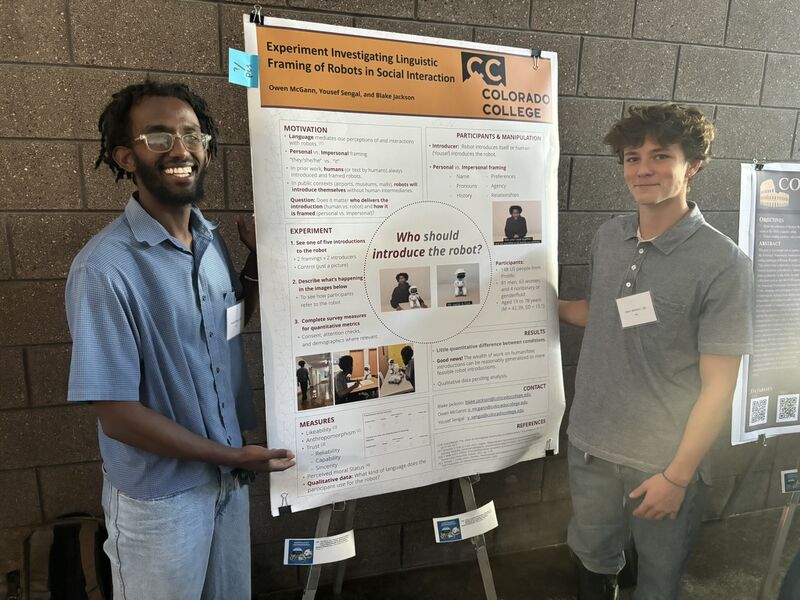
Computer Science majors Owen McGann ’26 and Yousef Sengal ’27 spent last summer conducting research on Human-Robot Interaction (HRI) and how the language used to introduce robots can shape human perception.
McGann and Sengal worked with Dr. Blake Jackson ’16, Assistant Professor of Mathematics and Computer Science, who first started research in this field while pursuing his PhD at Colorado School of Mines and who started this research project while teaching at Harvey Mudd College. Jackson worked with students there to develop the idea and design an experiment, but then got involved in other projects. He then returned to the idea with McGann and Sengal and since the field of social robotics had made significant developments, started revising the experiment design.
“Owen and Yousef were a joy to work with,” says Jackson, who graduated from CC with a degree in Computer Science. “Owen, Yousef, and I collaborated closely on all parts of this study, from the initial design of the experiment to the preparation of experimental materials, to the analysis of the data.”
During their research, McGann, Sengal, and Jackson completed a 2x2 online experiment test to see whether personal compared to impersonal introductions, delivered either by the robot or a human, affect how people rate a robot’s trustworthiness, likability, anthropomorphism, and moral status.
“Though we still have qualitative data to analyze, our measures of trust, likability, anthropomorphism, and perceived moral status show very little difference between conditions, which is excellent news for robot designers because it suggests that the wealth of experimental work on human delivered robot introductions can be reasonably generalized to analogous robot-delivered robot introductions, which we expect to be much more practical and common in many contexts,” the researchers explained when presenting their work.
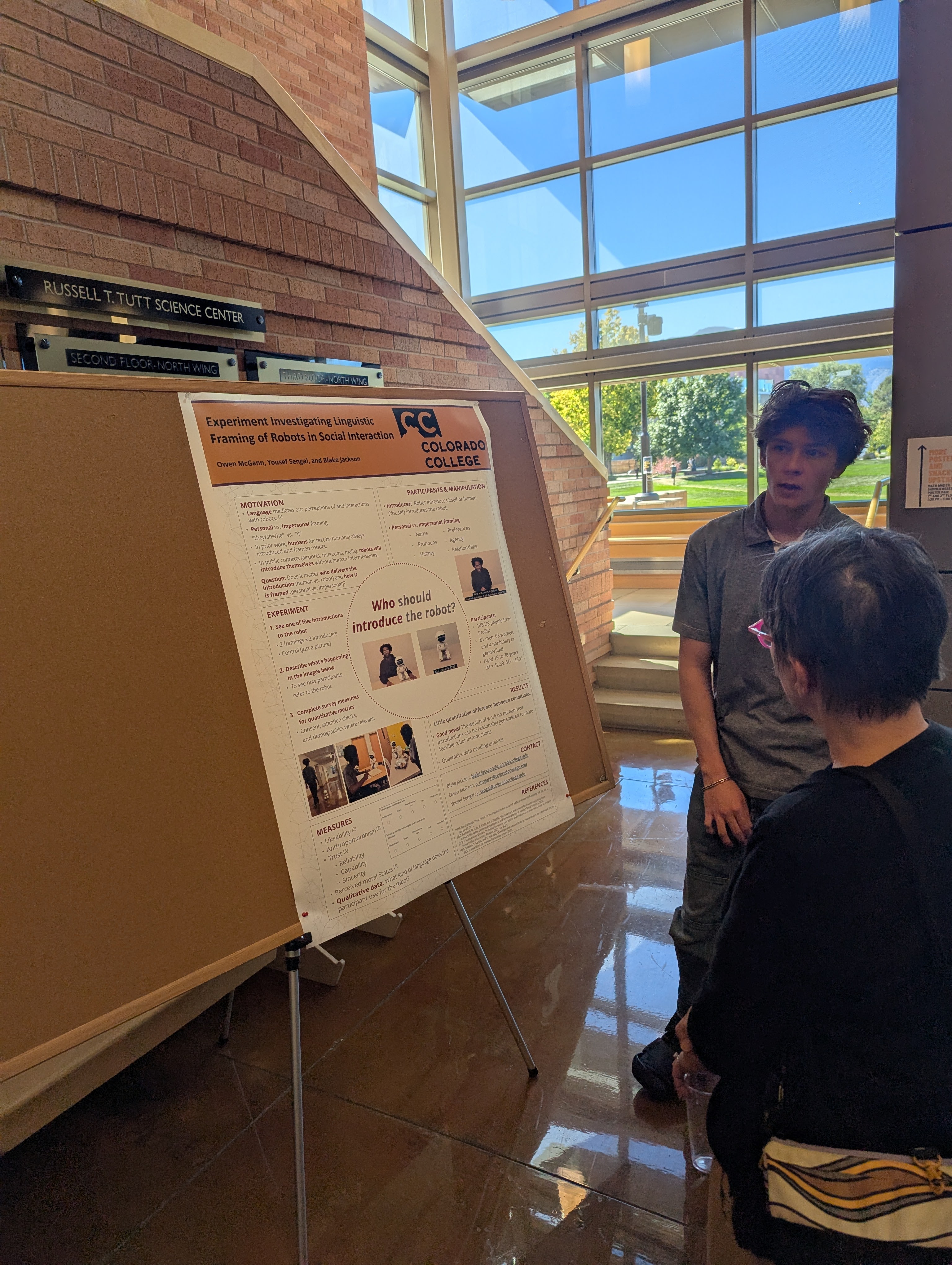
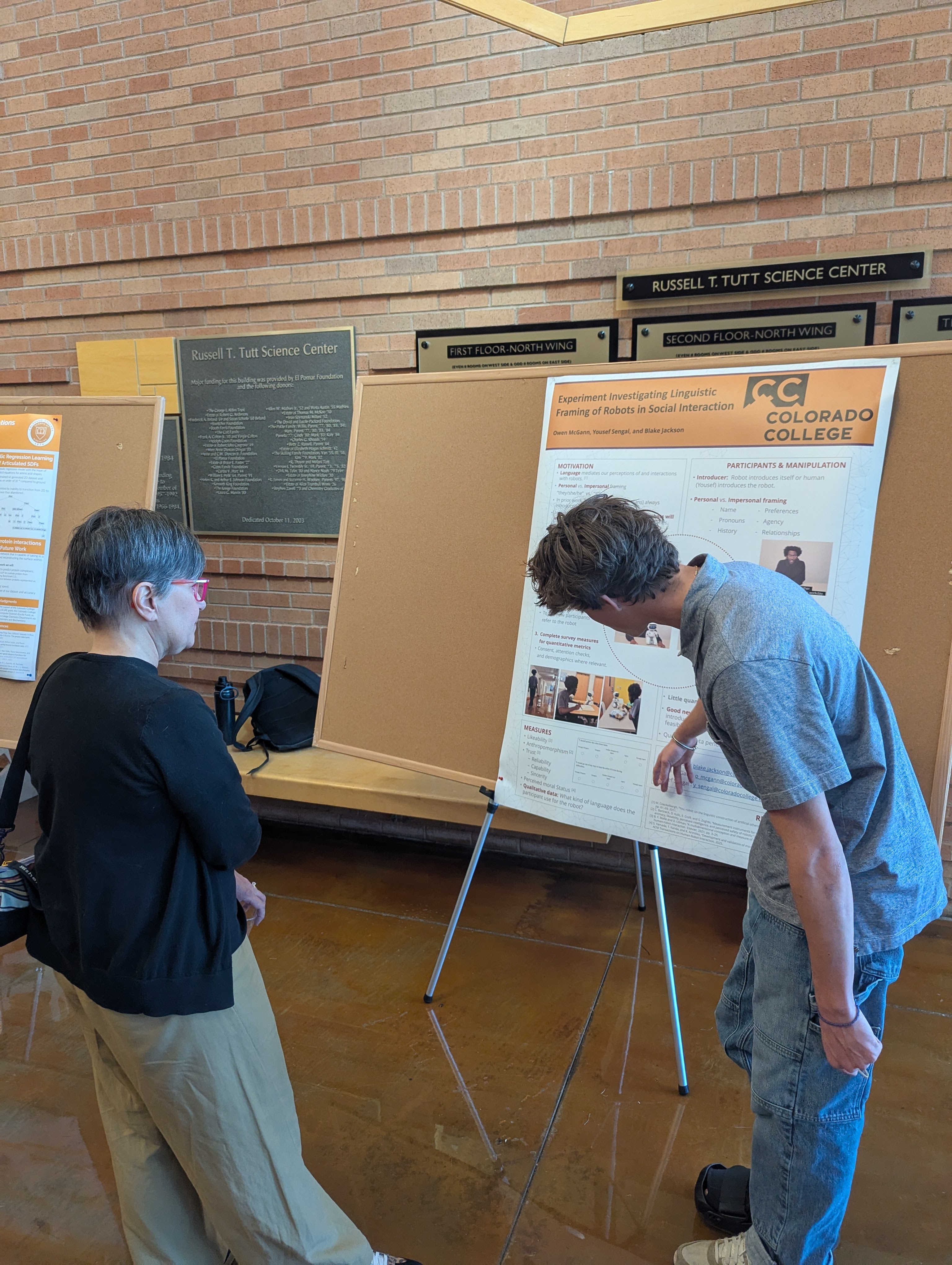
McGann and Sengal presented their research, entitled, “You Never Get a Second Chance to Make a First Impression: Using Introductions to Frame Mental Models of Social Robots,” at the September 2025 Summer Faculty-Student Collaborative Research and Internship Symposium.
“Presenting at the symposium was a really valuable experience,” McGann says. “It was the first time we had the chance to share our findings with people outside our immediate research group, and it was rewarding getting to explain the project to students, faculty, and even people who weren’t familiar with Computer Science. It also helped me feel a lot more confident presenting research in front of academics.”
McGann, Sengal, and Jackson say both philosophers and computer scientists have long theorized that the language people to use to talk to and about social robots can influence their mental image of the robot.
However, the researchers pointed out that many previous experiments have investigated the effects of using a personal versus impersonal framings when introducing the robot to new interactants, and they have had mixed results.
“In those studies, the introduction providing the linguistic framing of the robot was always delivered either by a human familiar with the robot or by text written from the point of view of such a human,” McGann and Sengal wrote in their project description. “However, many interactions that the average person might have with social robots currently or in the near future in public places like airports, museums, or shopping malls do not necessarily include the opportunity for a roboticist to deliberately supply a linguistic pre-definition beforehand.”
Therefore, the researchers were interested in a robot linguistically (pre-)defining its own identity in the very beginning of an interaction with a human, which they believe has not been well-studied.
Their day-to-day research schedule was very structured but collaborative. McGann and Sengal worked on the literature review, background research, and survey design independently and then met with Jackson at noon every day to check in. The researchers often utilized the Tutt Science Lounge where they had consistent access to equipment and open space to conduct experiments.
McGann was able to participate in this research through the Student Collaborative Research (SCoRe) program, which provides funding and support for student-faculty research collaborations. Students and faculty spend the summer working together to conduct research and then present their work at the Summer Symposium. Sengal was able to participate in the research through CC’s Euclid Scholars program.
McGann says the SCoRe program provides a really great opportunity for students, especially ones who are still deciding which industry they want to work in. McGann and Sengal both stress that CC’s strong emphasis in a liberal arts education gives STEM students a significant advance in their field.
“For STEM and Computer Science students especially, the liberal arts environment provides a real advantage,” McGann says. “We’re encouraged to be well-spoken, good writers, and strong critical thinkers, not just programmers or technical problem solvers. These communication skills we have been building up matter a lot, because so much of the work is explaining your ideas clearly through being able to write, present, and connect your work to broader human or ethical questions. I’ve noticed that this is something that really separates CC students from those at big tech schools…we’re trained to look at problems from multiple angles and to articulate our reasoning proficiently.”
Last spring, CC was recognized with Carnegie Classification’s new Research Colleges and Universities (RCU) designation, which highlights the significant research CC’s students and faculty conduct. At the time of recognition, CC was one of only 36 national liberal arts college, one of only ten liberal arts college in the west, and one of only three Associated Colleges of the Midwest, to be designated as an RCU.
“The RCU designation is really exciting because it reflects what I think students already feel on campus, that even though CC is a liberal arts college, there is still a strong emphasis on meaningful research,” McGann says. “I think the combination of liberal arts and research is one of CC’s biggest strengths. We get access to small classes, close mentorship, and a lot of freedom to explore our ideas, while also having access to real research experiences that would normally be reserved for graduate students at larger universities.”
The researchers are now finalizing their paper and plan to submit it for publication soon.
“The idea of eventually having our work published means a lot to me,” Sengal says. “I’ve spent years reading and learning from other people’s research, so being on the other side of that process would really feel like a full-circle moment.”