International Student & Scholar Services
International Student & Scholar Services
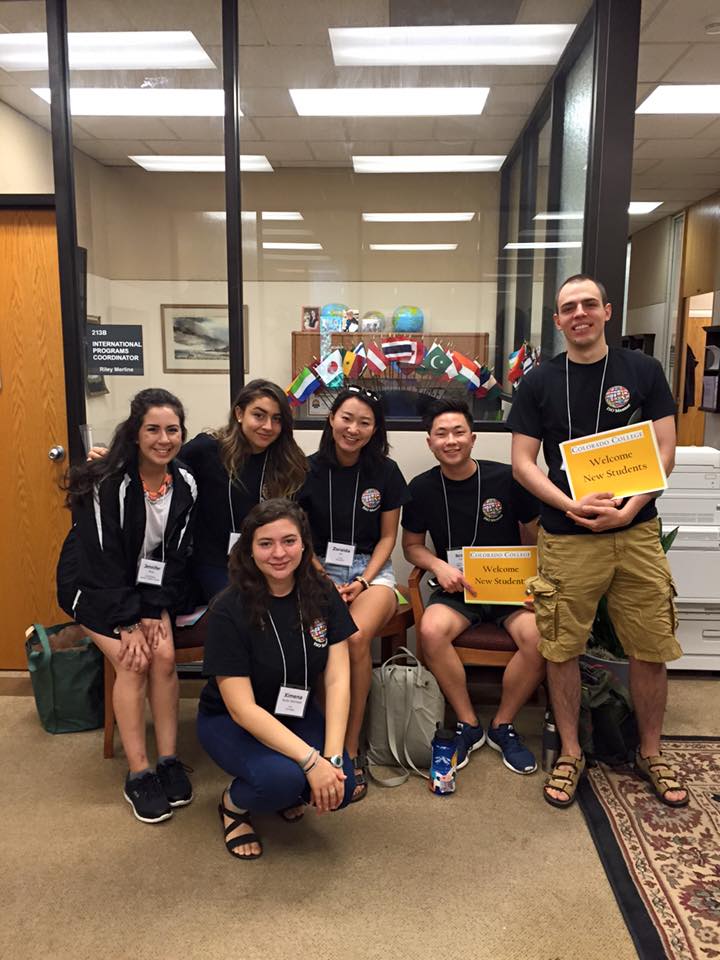
Colorado College is home to international students from over 50 countries and a rich community of international faculty and visitors from all over the world. If you are an international student or faculty member, you will be in close contact with the International Student & Scholar Services (ISSS) team. We provide a wide array of services to our international CC community as well as academic departments. Our staff is comprised of people who are truly interested in the well-being of international students and scholars.
RESPONSIBILITIES
- Advising and interpretation of U.S. government regulations for students with an F-1 or J-1 visa
- Serving as liaison with the U.S. Department of State, the U.S. Department of Homeland Security, sponsoring agencies, community cultural agencies and foreign embassies
- Providing orientation and informational programs
- Offering support with cultural adjustment and navigating the U.S.
- Promoting intercultural exchange programs between international students and the campus community
- Advising and supporting international faculty with their immigration status
Final Rule Ending Duration of Status (D/S) for F and J nonimmigrants
UPDATE:
The Department of Homeland Security’s new rule ending Duration of Status will not take effect on Sept. 15, 2026, as previously announced. On Sept. 14, a federal judge issued a nationwide preliminary injunction temporarily blocking implementation of the rule.
As a result, the longstanding Duration of Status framework for F-1 students and J-1 students and scholars remains in place for now. It is important to note that litigation is ongoing, and the federal government may appeal the court’s decision. The court has not yet issued a final ruling on the underlying case.
What this means for Colorado College students and scholars: There is no change to the current Duration of Status framework at this time. International Student & Scholar Services (ISSS) will continue to monitor the litigation and provide updates as new information becomes available.
Final Rule Ending Duration of Status (D/S) for F and J nonimmigrants
On July 17, 2026, the U.S. Department of Homeland Security issued a final rule replacing admission for Duration of Status (D/S) with fixed periods of stay for F-1 and J-1 nonimmigrants.
What is Duration of Status?
F-1 students and J-1 exchange visitors are currently admitted to the United States for Duration of Status (D/S), meaning you may stay as long as you remain in valid immigration status and meet your program requirements. D/S has been a federal government policy for more than 30 years. On Friday, July 17th, the U.S. Department of Homeland Security published a final rule in the Federal Register that replaces the longstanding Duration of Status (D/S) policy for F-1 international students and J-1 exchange visitors. The new rule eliminates the current D/S policy, replacing it with a fixed period of stay, capped at four years, plus a 30-day grace period.
Under the new regulations, F-1 and J-1 nonimmigrants will now be admitted to the U.S. for a specific period of stay and will be required to apply for an extension of stay (EOS) through U.S. Citizenship and Immigration Services if they need more time to complete their program, employment, or transfer to another level of study.
Effective Date & Key Timeline
Publication: July 17th, 2026 in the Federal Register
Effective Date: 60 days after publication, September 15th, 2026
Note: 4-year transition period for existing D/S holder: F/J nonimmigrants already in D/S on the effective date do not need a corrected I-94 and may remain in D/S through their program end date or 4 years after the effective date, whichever comes first. These individuals will not have to immediately apply for a date-certain I-94. However, they must still apply for an extension of stay in order to remain in status beyond the program end date on their current Form I-20 or DS-2019, or four years from the final rule effective date, whichever is shorter, and will also be subject to the new academic restrictions in varying ways. If someone in this transition group exits the United States and reenters on or after September 15, 2026, CBP will readmit them with a form I-94 with a date-specific.
The Office of International Student & Scholar Services is actively reviewing and analyzing the rule so that we can provide accurate, personalized guidance to our community. We will reach out directly to students and scholars impacted by the rule as well as staff and faculty in impacted CC departments to help you understand what the rule changes mean for you. Additionally, we plan to offer a series of webinars for students, scholars, and departments in the coming weeks; these will be announced via email and through the ISSS website.
Disclaimer
The information provided by the International Student and Scholar Services Office is intended for general informational purposes and reflects Colorado College's understanding of current U.S. immigration regulations and guidance related to the F-1 and J-1 nonimmigrant classifications. It is not legal advice and should not be relied upon as a substitute for advice from qualified legal counsel. Information on locating legal counsel can be found here.
What do these changes mean for you? The core changes are as follows.....
Maximum period: Typically, F-1 students will be admitted to the United States for a fixed period of time, up to the length of the program of study listed on their Form I-20, "Certificate of Eligibility for Nonimmigrant Student Status," not to exceed four years, plus a 30-day period for arrival and an additional 30-day period for departure. This fixed period of time is indicated by the Admit Until Date (AUD) on their Form I-94, "Arrival/Departure Record."
Extension of Stay (EOS) will now be filed on Form I-539 (Application to Extend/Change Nonimmigrant Status) with U.S. Citizenship and Immigration Services (USCIS). The Designated School Official's role becomes recommending/documenting; USCIS is the final decision-maker.
- USCIS may require biometrics (fingerprints, photos, signature) in conjunction with an EOS decision.
- If an EOS is denied after the admission period has expired, the student (and dependents) must depart immediately. 8 CFR 214.2(f)(7)(vii)
- Extensions are intended for academic/medical delays. Delays from academic probation, suspension, repeated course failure, or unwillingness to progress are generally not acceptable grounds for an EOS.
Undergraduate students
- Cannot transfer schools or change educational objectives (major) during the first academic year without an SEVP-approved exception for extenuating circumstances (e.g., school closure, loss of SEVP certification, program discontinuation).
- After completing one academic year, students may transfer and/or change majors normally.
Graduate students
- May not transfer schools after beginning the program, and may not change educational objectives/major at any point during the program. This restriction does not lift away after year one the way it does for undergraduates. Exceptions are limited to SEVP-approved extenuating circumstances.
Degree-level ("upward progression") rule
- Once an F-1 student completes a program at one educational level, they generally cannot begin another program at the same or a lower level as an F-1 student (e.g., a second Bachelor's after completing one).
- A student removed from a program generally must depart the U.S. and re-enter on a new SEVIS record (new I-901 SEVIS fee) to begin a new program.
- The standard post-completion / post-OPT grace period drops from 60 to 30 days. This is also the outer window for a student to request a start date after a program end date, and the required timeframe for filing an EOS or OPT application near program completion.
- Students admitted under "Duration of Status (D/S)" before the effective date keep their original 60-days grace period for that specific transition cohort but travel out of the U.S. will affect your D/S and when you reenter the U.S., CBP will readmit you with a form I-94 with a date-specific I-94 and an adjustment to your grace period.
show all / hide all
Federal Register
Read the final rule in the U.S. Federal Register
Study in the States - FAQs for Elimination of Duration of Status
Study in the States offers answers to the most frequently asked questions about the elimination of Duration of Status final rule for F and J nonimmigrants.
NAFSA response to regulatory changes
Contact Us
Visit Us
Armstrong Hall 217-218
Report an issue -
Last updated: 09/15/2026