


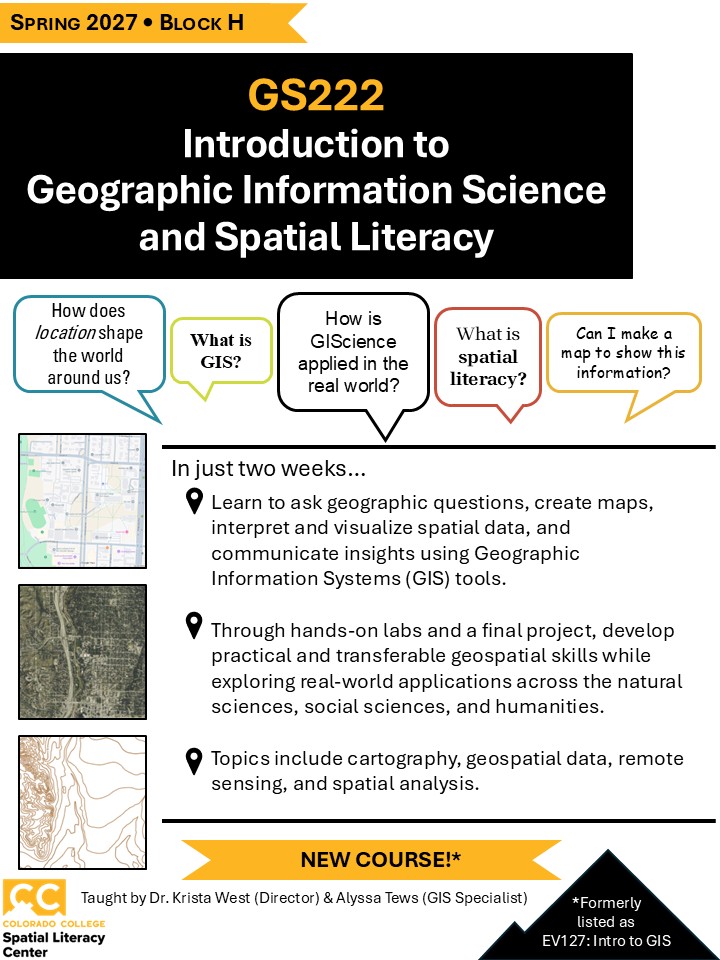
GS222: Introduction to Geographic Information Science and Spatial Literacy (Half Block)
General Studies Courses
GS100 - Bridge Scholar Programs:
Introduction to a liberal arts topic, covering source material in depth and stressing methodology, research, presentation, and writing. 0.25-0.5 units. Taught as a regular block prior to NSO (0.5 unit) or as adjunct (0.25 unit).
.25 unit — Wiehe
GS103 - Communication for Collegiate Success
(Not offered 2026-27).
.25 to 1 unit
GS105 - The Power of Data and Models
The ability to use data and basic algebraic models (economic, biological, physical) gives you tools to investigate more deeply key concepts in a variety of disciplines. This adjunct course is designed to help students improve their skills in college algebra and precalculus skills in a context of investigating datasets and basic models. More broadly, a course goal is to help students be more successful in rigorous, gateway or required courses to majoring in math, science, and economics at Colorado College. Parts of the adjunct will involve teamwork with data and models, while other segments will be tailored to the individual’s progress in ALEKS (Assessment in LEarning in Knowledge Spaces) learning modules. 0.25 unit. (Not offered 2026-27).
.25 unit
GS106 - Practicum in a Community-Based Organization
*
.25 or .5 units — Radke
GS110 - Stroud Scholars Composition Year 1
(Not offered 2026-27).
GS111 - Stroud Scholars Quantitative Reasoning Year 1
(Not offered 2026-27).
GS118 - Topics in Community Engagement:
Integrates theory and experiential learning to introduce core concepts and models of effective, equitable, and intentional engagement with communities beyond the campus. This community-engaged learning (CEL) course aims to deepen the perspectives and skills needed to apply a liberal arts education toward solving public problems in inclusive, democratic ways. Pass/fail only. No laboratory. (Not offered 2026-27).
.25 or .5 units
GS120 - Critical Approaches to the Liberal Arts
This course introduces students to theoretical concepts and interpretive methods deployed in analyzing the nature, structures, and practices of the liberal arts. The goal is to prepare students to participate in critical discussions about the different ways that people experience, interpret, and find meaning in the context of a liberal arts education. The course will focus on three major themes in philosophy of education: the aims of education; the practices and politics of knowing; and the nature of teaching and learning. The course also prepares students to work as mentors in the Colorado College First Year Experience program. Pass/Fail only; COI required; .25 units.
.25 unit — Wiehe
GS195 - Practicum in Community Engagement
This practicum provides a community-engaged experiential learning experience for students interested in working in public good sectors and changemaking. Students engage in at least 45 hours of supervised, focused capacity-building work for organizations in the nonprofit or public sector, toward mutually beneficial goals that promote student learning and community impact. Students participate in structured, guided group and individual reflection and culminate their experience in a final assignment that connects theory and practice. Through the practicum, students have the opportunity to apply academic knowledge and skills to real-world contexts; learn-by-doing in unscripted, diverse, nuanced situations; and learn from practitioners. Can be taken Pass/No Credit only.
.25 unit — Radke
GS196 - Practicum in a Community-Based Organization:
This practicum provides an immersive, embedded, community-engaged student learning experience within a single organization in the public good sector. Students engage in 40-80 hours of supervised, focused capacity-building work for the organization, toward mutually beneficial goals that promote student learning and community impact. Along the way, students participate in guided reflection and relevant skill-building, culminating their experience in a final assignment that connects theory and practice. Through the practicum, students have the opportunity to apply academic knowledge and skills to real-world contexts; learn-by-doing in unscripted, diverse, nuanced situations; and learn from practitioners. No laboratory. Offered P/NC only.
.25 or .5 units
GS198 - Internship
The GS: Internship Adjunct provide students with a significant learning experience outside the classroom setting, usually being placed with a company, non-profit or community-based organization. The internship represents an educational strategy that links classroom learning with the application of knowledge in an applied work setting. Students participate in an internship for at least four weeks and no less than 40 hours of supervised work. The General Studies: Internship Adjunct is taken under the pass/fail grading option. The course is a no credit option. The GS: Internship Adjunct does not meet divisional distribution requirements. Prerequisite: Sophomore, Junior or Senior status.
to .25 units
GS199 - Internship
Students are provided with a significant learning experience outside the classroom setting, usually being placed with a company, non-profit or community based organization. The internship represents an educational strategy that links classroom learning with the application of knowledge in an applied work setting. Students participate in an internship for at least four weeks and no less than 40 hours or supervised work.
.25 unit — de Araujo
GS202 - Introduction to Urban Studies
By 2050, two-thirds of the world’s population will live in cities. This transformation to an urbanized world impacts everyone and has important implications for politics, societies, cultures, economies, and more. This course provides a framework in which urban phenomenon can be analyzed and understood through introducing students to the interdisciplinary field of urban studies. Using a variety of Western and non-Western cities as illustrative examples, the course aims to give a broad survey of the distinctive characteristics of urban places as well as the processes that shape them. Topics covered may include urban planning, the function of cities in their regional and global economies, community organizing and urban social movements, gentrification and housing development, urban governance, surveillance, urban environmentalism, and more.
1 unit — McKendry
GS205 - Reading Practicum
This 0.25 credit course develops active reading strategies and skills necessary for students to read successfully at the college level. The course will be taught primarily in a workshop format, using group discussions, directed readings, small group activities, and written reading-response assignments. Students at all levels of reading proficiency are encouraged to enroll in order to improve reading comprehension and speed, expand critical reading skills, and enhance reading proficiency across the liberal arts curriculum. (2 consecutive blocks) (Not offered 2026-27).
.25 unit
GS210 - Foundations of Radical Nonviolence
The Foundations of Radical Nonviolence course examines the theory and practice of radical nonviolence. The course has a cultural and systemic lens, covering a broad range of disciplines including philosophy, religion, art, history, and science, as well as modern day practitioners in order to examine nonviolence as a powerful social force. Students will meet many guests who are practitioners and activists, exploring war and its effects on humans and the planet, strategic nonviolent conflict, prison abolition, civil disobedience, forgiveness, restorative justice, and nonviolent history. Creativity and independent research are highly encouraged in this course, and there is a heavy focus on connecting theory and practice. Meets the Critical Perspectives: Social Inequality requirement. Meets the Equity and Power: EPUS requirement. (Not offered 2026-27).
1 unit
GS213 - Advanced Approaches to Academic Success for CLD Students
This course, designed for first-year culturally and linguistically diverse (CLD) students, will promote academic success during their transition to Colorado College. Meetings occur three times each block and may cover a range of topics including but not limited to their first semester coursework, research and ethical scholarship skills, writing in academic genres, reading and oral presentation strategies, language support, and culturally-contextualized rhetorical practices.
.5 unit — Walter
GS214 - Workshop in the Digital Liberal Arts
This adjunct course is designed for students to work individually or in groups on a digital research project. Under the supervision of faculty, IT specialists and/or librarians, students research a focused topic grounded in their major or another field in which they have expertise and learn how digital technology can best be used in this scholarly endeavor. Course meets two times per week over the course of two blocks, two-and-a-half hours each meeting. Course may be repeated with a different research project. .5 units. Instructors: Faculty with the support of IT staff and Librarians. (Not offered 2026-27).
.5 unit
GS215 - Colorado College Social Action Institute
This .25-credit mentored internship program is an opportunity for students to engage in activist and/or advocacy work that aims to uphold/construct participatory democracy by addressing the criminalization of immigrant communities, low-wage workers, and other vulnerable populations through direct collaboration with community-based organizations in the U.S. Southwest. During the 6-week program, students work in one of three program tracks: Community Organizing to Support Labor, Tenant/Housing, and/or Immigrant Rights; Environmental Justice Work, or Immigrant Detention Work and Movement Lawyering. The program begins with a one-week orientation that incorporates multidisciplinary reading and discussion focusing on the racial and class dimensions of carceral capitalism and immigrant detention, community and labor organizing theory and practice, immigration policy, and movement lawyering practices. National activists will conduct workshops during the orientation. During the program, students learn skills to engage in activism/advocacy work, participate in discussions focused on conceptions of social change, and explore activist/advocacy/legal and policy career possibilities. Students write several reflective papers, prepare a substantive presentation for their respective host community organization during the last week and return to Colorado College for several days of debriefing activities. (Not offered 2026-27).
.25 unit
GS216 - Introduction to Journalism
Basic skills of the discipline, focusing primarily on news, analysis, feature and editorial writing (including research, fact-checking, interviewing), but dealing also with editing, layout, journalistic ethics, libel laws.
1 unit — Hutchins
GS217 - Practice in Journalism
A semester-long extended format course, designed and executed with faculty supervision, that combines practical experience in journalism with theoretical reading, an annotated portfolio of work completed, and a journal of reflections leading to an overview of the semester. The course can be taken twice and is limited to one unit counting towards the degree. (Not offered 2026-27).
.5 unit
GS222 - Special Topics:
Selected topics will be discussed and will vary from year to year.
.25 or .5 or 1 unit — Bertsche, Broady, Bruder, Chui, Getty, Hinkle, Rosenthal, Salsbury, Stoller, Tabares, West, Woodard
GS232 - Unraveling Europe
What is “Europe”? What does it mean to be “European”? Who gets to define the boundaries of Europeanness, and what groups have been included or excluded, centered or marginalized as a result? This course seeks to answer such epistemological questions by unraveling and deconstructing some of the central, naturalized, imposed, and often monolithic narratives that have been projected onto and out from Europe. Examining these mechanisms from a critical perspective, students will look at the diverse cultural, linguistic, national, religious, ethnic, racial, and other factors that have continued to shape Europe throughout its history. They will consider debates around issues of identity and ideology, including the histories and legacies of colonialism, imperialism, fascism, and racism, and learn to view Europe as a place of multiplicity and difference, changing institutions, and ever-shifting borders. Taking a transdisciplinary approach that includes literary studies, art history, race and ethnic studies, film and media studies, cultural studies, history, and geography, among other fields and theoretical frameworks, “Unraveling Europe” unsettles the common assumption that Europe is and always has been fundamentally European. Meets the Equity and Power: EPG requirement. (Not offered 2026-27).
1 unit
GS233 - Topics in Journalism:
*
1 unit — Alters, Breslow, Bzdek, Finley, Hayward, Hutchins, Lindau, Oldham
GS243 - Stroud Scholars Composition Year 2
(Not offered 2026-27).
GS244 - Stroud Scholars Quantitative Reasoning Year 2
(Not offered 2026-27).
GS257 - Topics in Reading and Rhetoric in the Liberal Arts:
This course examines what it means to read on both a theoretical and practical level. Focusing on readings concerning the transactional theory of reading, students will consider the influence of the background knowledge and beliefs they bring to texts as well as the way in which the text can prompt transformations in their thinking and believing. In the process of reading and discussing the assigned materials, the students will also develop and polish college level reading skills. This course will be taught in a seminar fashion, with small and whole group discussion, assigned readings and reading-response short papers. Meets the Writing in the Discipline requirement.
.5 unit — Kanaskie
GS261 - The Idea of Latin America
This course will examine contemporary understandings of “Latin America” from a multidisciplinary perspective. Recognizing the constructed nature of the term, the course offers an overview of critical topics, such as: colonialism and its effects; linguistic and cultural diversity; environmental issues; class, gender, race and ethnicity; and US-Latin America relations. Meets the Equity and Power: EPG requirement.
1 unit — Castro
GS300 - Theory and Practice of Peer Tutoring
This course has two purposes: (1) to delve into the complex processes involved in writing and talking about writing; and (2) to prepare students to work as writing consultants in the Colorado College Writing Center. Key course themes include the theory and practice of writing, the theory and practice of tutoring, critical thinking, self-awareness, and team building. Students will have the opportunity to discuss and apply theories to specific tutoring situations, role play, solve problems in groups, and practice tutoring. Applications are due in the fall; check the Writing Center webpage for exact dates. The course is held annually during half-block.
.5 unit — Schacht
GS309 - Independent Study:
Supervised reading and structured reflection following a student's participation in a Colorado College Student Exchange or Affiliated study abroad program, culminating in a research essay and/or extensive creative work plus a reflective journal/portfolio on the international experiences. A presentation to the college community may be incorporated into the independent study, but will not substitute for written work.
.5 to 1 unit
GS314 - Independent Study in Journalism
This course has two components: a practicum in journalism and an integrated project designed to accompany the student's course work in the minor. The student's work in the practicum will be evaluated by the on-site supervisor; the supervisor's reports will be reviewed by the minor advisor. The project should be designed by the student in consultation with the minor advisor and course instructor(s). The project should involve a critical component: it should enable the student to explore and critically reflect upon the construction of newsworthy material, the formal and generic constraints of journalistic writing, and the shaping ideologies, both subjective and institutional, of specific instances of journalism. (Only open to students who are pursuing the Thematic Minor in Journalism.)
1 unit — Hutchins
GS320 - Independent Study
Supervised readings or in-field investigations in areas of interest to the students that are interdisciplinary in nature and cross divisional lines within the college. The readings and/or investigations will be followed up with discussions and written reports. Must be approved and supervised by two faculty members from different divisions of the college.
.5 to 1 unit
GS330 - Urban Investigations
Guided exploration of a topic in urban studies chosen with the instructor's approval. Satisfies the integrative experience requirement for the Urban Studies thematic minor.
1 unit — McKendry
GS343 - Stroud Scholars Composition Year 3
(Not offered 2026-27).
GS344 - Stroud Scholar Quantitative Reasoning Year 3
(Not offered 2026-27).
GS350 - Interdisciplinary Research: Process and Theory
Seminar exploring the nature of interdisciplinary research and the processes through which research integration occurs. Designed so that Independently Designed Majors can complete a research proposal to carry out in their senior thesis, but others may be admitted with the consent of the department.
1 unit — Stoller
GS352 - Off-Campus Study/Abroad Semester Placeholder
(Not offered 2026-27).
4 units
GS390 - Grant Writing
Facilitates the development of the research skills, audience awareness, clarity of purpose, and persuasive rhetoric necessary for writing grant applications for individuals and for groups. Provides students the opportunities to write a grant for an individual project and experience aspects of the grant-writing process for an organization. Meets once per week over 4 blocks. As this course requires substantial writing, revision, and response, course seats will be capped at 12.
.5 unit — Sartin
GS391 - Senior Thesis/Ind. Stdy Course
Placeholder Course for students during preregistration. They should use this course at preregistration time instead of leaving the block blank! The correct version will be added to the students schedule after preregistration is over.
or 1 unit — Apodaca
GS392 - Study Abroad Placeholder
Use this course as a placeholder to indicate where you have already applied or will apply for a Study Abroad or Away program or block through the CC Center for Global Education & Field Study. This placeholder course does not admit or enroll you in any study abroad program on its own.
1 unit — Powell Browne
GS395 - Peer Tutoring Practicum
*
.5 unit — Schacht
GS399 - Topics in Advanced Writing Projects
This course will provide students with strategies for approaching advanced writing projects, such as senior thesis papers, grant and scholarship applications, and essays for graduate and professional schools. Students will learn methods for research, invention, drafting, organization, and revision. By the end of the class, students will have produced a significant piece of writing for a class or an independent project. As this course requires substantial writing, revision, conferencing, and response, course seats will be capped at 12.
.25 unit — Kanaskie
GS400 - Senior Thesis I
Thesis subject of integrative project to be developed by the student with the approval of the advisor. For liberal arts and sciences majors or students doing the integrative project of Thematic Minors. Offered any block of the year.
1 unit — Atuire, Bang, Evitt, Fish, Gamboa, Gardiner, Golightly, Guerra, Heschel, Hourdequin, Richman, Sancier-Barbosa, Sico
GS401 - Senior Thesis II
Completion of the senior thesis and oral defense with faculty sponsors. Liberal Arts and Sciences majors only. Offered any block after 400 Senior Thesis I.
1 unit — Atuire, Bang, Evitt, Golightly
GS402 - Working with Culturally and Linguistically Diverse Writers
In this course, Writing Center consultants will engage with concepts and applications of second language writing pedagogy, culturally and linguistically responsive pedagogy, and linguistic justice. Consultants will utilize and build upon their knowledge and experience as a writing center consultant.
.25 unit — Walter
GS520 - MAT:
.25 to 1 unit
GS551 - Experienced Teacher Independent Readings
.5 unit
GS552 - Experienced Teacher MAT Capstone Seminar
(Not offered 2026-27).
.5 unit
GS554 - Experience Teacher Institute:
(Summer only 2026-27).
.5 to 2 units